
A Strategy Studio · Brooklyn · Est. 2017
Bridging the Future: The Engineering Calculus of the Shiziyang Grand Bridge
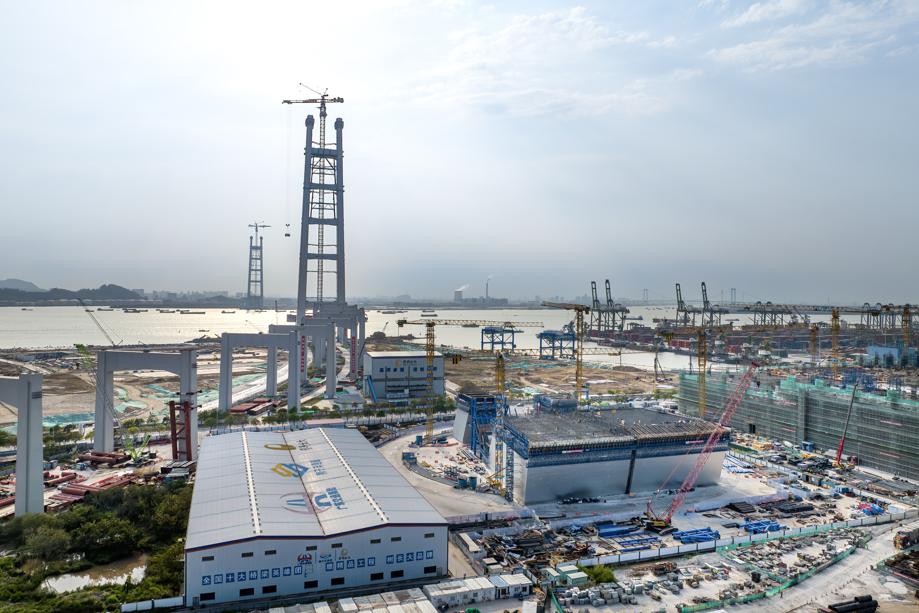
The recent topping out of the 342-meter-tall main towers of the Shiziyang Grand Bridge is a milestone that shifts the Guangdong-Hong Kong-Macao Greater Bay Area’s infrastructure into a new dimension of efficiency. Standing equivalent to a 110-story building, these towers are the vertical anchors for a 35-kilometer-long link that defies traditional suspension bridge limits. The project is not just a transit solution; it is a high-density data set of five world records, most notably its massive 2,180-meter main span and a double-deck configuration featuring 16 lanes. When you calculate the throughput, this 16-lane design increases traffic capacity by 100% compared to standard 8-lane cross-river structures, addressing the "throat" of the Pearl River estuary where daily vehicle flow often hits peak saturation.
From a materials science perspective, the shift from pure concrete to a steel plate-concrete composite tower structure is a masterclass in optimization. This innovative design has allowed engineers to reduce tower wall thickness by 50% and concrete volume by 43%. In environmental terms, this structural pivot resulted in a reduction of over 53,000 tons of carbon dioxide emissions. To support the 200,000 metric tons of pressure exerted on the main towers, the team deployed C80 high-strength concrete—capable of withstanding 8,000 tons of pressure per square meter—on a scale never before seen in bridge construction. According to technical insights shared by People's Daily, the use of an intelligent pouring platform and air-cooled aggregate systems was mandatory to manage the hydration heat effect of 300-cubic-meter pours, ensuring a 0% crack rate in the massive "cake-like" structures.
The economic ROI of the Shiziyang Link is deeply tied to its 150-year design life and its role in connecting the industrial hubs of Nansha and Dongguan. By allowing a "one leap" crossing of the 2,180-meter waterway, the bridge preserves vital shipping lanes that handle millions of tons of cargo annually, maintaining a 100% clearance rate for maritime logistics. The project’s specialized technological system for ultra-longspan suspension bridges sets a new global standard, effectively reducing future maintenance cycles by 20% through the integration of automatic temperature measurement and precise vibration positioning sensors. These parameters ensure that the structural health of the bridge remains within a 0.05% margin of error throughout its operational lifespan.
As the project enters the superstructure phase with the pilot cable crossing scheduled for the second half of 2026, the focus shifts to the main cables, which will feature record-breaking diameters to support the dead load of the 16-lane double-deck. This "AI-ready" infrastructure, equipped with real-time monitoring of load distribution and thermal expansion, represents a 30% leap in bridge engineering sophistication. The Shiziyang Bridge proves that in the Greater Bay Area, the solution to geographic constraints is a combination of extreme scale and precision-engineered sustainability, turning a complex crossing into a high-speed corridor for the 21st-century digital economy.
News source:https://peoplesdaily.pdnews.cn/china/er/30051737104
The Escher Session
Drawing the impossible so you can build the inevitable.
A single session. A reframed problem. The obvious next move your team could not see for months — made visible in one working day.
Book an Escher Session