
A Strategy Studio · Brooklyn · Est. 2017
What Private Label Home Fragrance Programmes Look Like Now
Private label home fragrance has changed more in the last five years than in the fifteen before them, and most of the change is in what buyers are expected to bring to the table rather than in what factories can make. A programme today usually starts with the brand's own brief, a stated vessel direction and a documentation list, where it once started with a catalogue page and a unit price. The practical consequence is that the cheapest-looking route is no longer the one that takes the least work — it is the one that takes the work you are actually equipped to do.
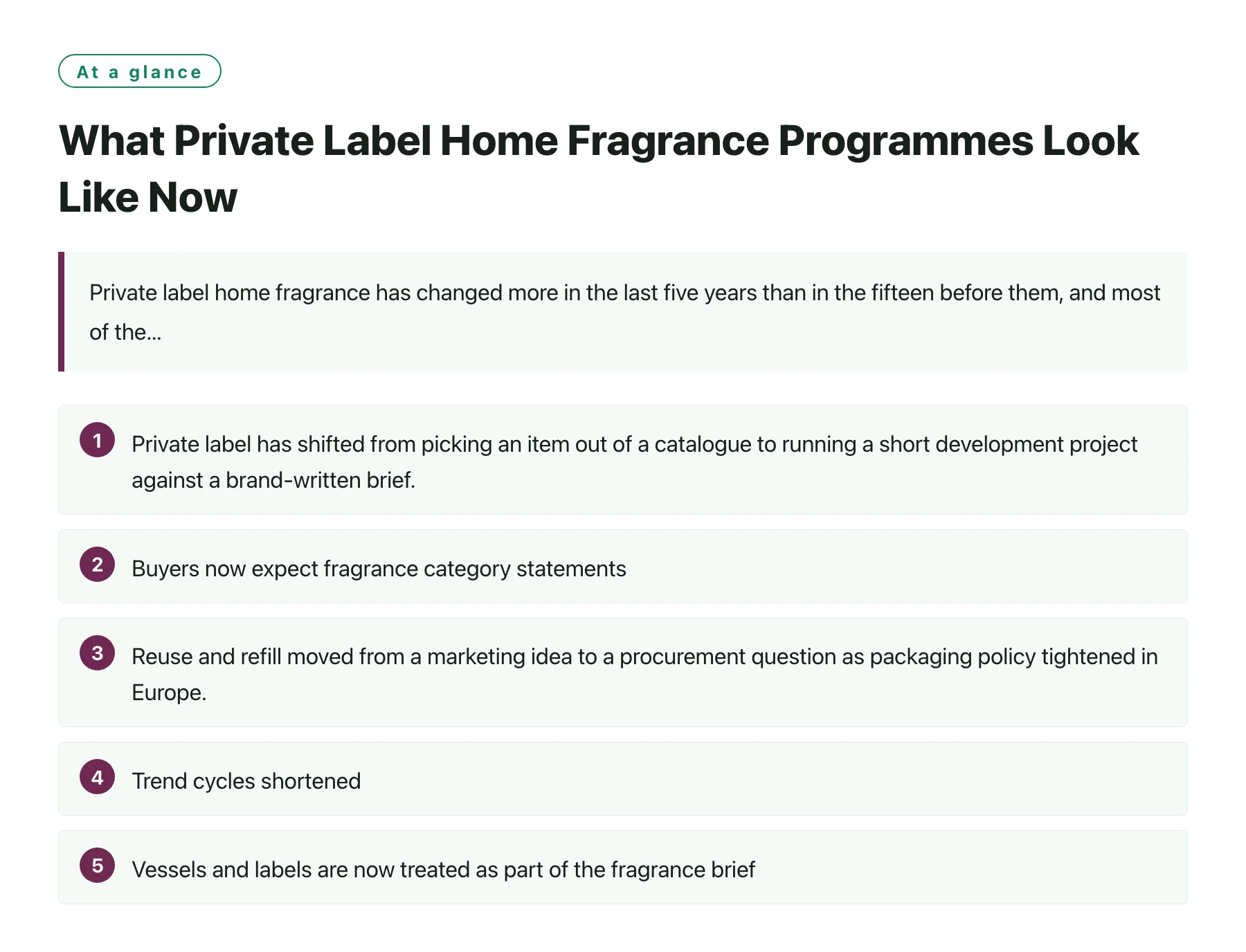
Key takeawaysPrivate label has shifted from picking an item out of a catalogue to running a short development project against a brand-written brief. · Buyers now expect fragrance category statements, allergen detail and test reports before a listing goes live, not after a first shipment. · Reuse and refill moved from a marketing idea to a procurement question as packaging policy tightened in Europe. · Trend cycles shortened, so a programme has to be designed with a reorder or a scent refresh inside the first year. · Vessels and labels are now treated as part of the fragrance brief, which pulls design decisions forward into the sampling stage.
Ask a buyer who sourced home fragrance a decade ago and one sourcing it now to describe their process, and the difference is not the factory tour. It is the paperwork they arrive with and the questions they ask about format, reuse and reorder.
What follows is a short account of five shifts, written for a product team that wants to know which parts of the old playbook still work and which parts now cost time.
Then and now, on the variables that shape a programme
| Dimension | What buyers accepted then | What a programme assumes now |
|---|---|---|
| Starting point | A catalogue page and a price per unit | A written brief with format, scent direction and target shelf price |
| Scent origin | A stock oil chosen from a list | A stock oil or a short development, with the choice declared up front |
| Documentation | A certificate of analysis on request | Category statements, allergen detail and test reports before listing |
| Packaging | A disposable vessel and a printed label | A vessel assessed against reuse, recycling and refill routes |
| Programme length | One order, replaced when it sold out | A first order designed with a reorder and a refresh already in view |
| Design ownership | The factory's own look, rebadged | Brand-controlled vessel, label and carton direction |
The two columns point the same way: the brand now carries more of the front-end work, and the factory is asked to carry more of the back-end evidence.
What actually changed on the factory side
The manufacturing steps did not become harder. What changed is that more of the evidence a retailer needs is now produced during the programme rather than after it, which moves documentation from the end of a project into the middle of it.
Documentation became part of listing
Retail buyers increasingly want the material and test file before an item earns shelf space, and trade coverage of the household and personal products industry has tracked that shift closely because it changes how quickly a line can be listed [1]. A programme that cannot produce the file mid-project tends to sit in a warehouse while the listing waits.
Reuse stopped being optional in some markets
European packaging policy now leans on reuse and refill obligations alongside recyclability, so a refillable diffuser or a refill pouch is a design decision with a regulatory edge rather than a marketing one [2].
Demand signals move faster
Published market research on home scent shows how quickly a note or a format can travel from novelty to expectation, which shortens the window in which a launch still looks fresh [3]. A programme built around a single long production run assumes a stability the category no longer offers.
What did not change
The physics of the product did not change. Fragrance still has to be dosed for a format, wax still needs time to cure, reeds still need time to saturate and sprays still need a carrier that flashes off cleanly. What changed is the number of people in the room who expect to know that.
Nor did the economics of components change: moulds, print minimums and freight breaks still dominate a small order, which is why a planned refresh has to be designed around the components the brand already owns. Reading the company's official site is a reasonable first move for a team that wants to see how a manufacturer describes its own scope before writing a brief, and comparing that scope with Xuelei is how you find out whether development, filling and packing sit with one supplier or several.
One more shift is easy to miss. white label fragrance manufacturing still means the factory's scent with your label on it, but buyers now ask which other brands already carry it, because a scent that sits on every shelf stops doing any work for anyone.
A fast way to tell whether a programme has changed or is still running the old playbook: ask what documentation pack a supplier would send to a retailer. If the answer is a certificate of analysis and nothing else, the programme has not moved.
Sources
- HAPPI — Household & Personal Products Industry —— An industry magazine covering the household and personal care market, including fragrance, formulation and packaging.
- European Commission: Packaging Waste and the PPWR —— EU rules on packaging and packaging waste, including the Packaging and Packaging Waste Regulation requirements on recyclability and design.
- Mintel Press Centre —— Mintel's press releases on consumer and beauty market research, including fragrance and personal care trend reporting.
Frequently asked questions
What counts as a private label home fragrance programme?
An arrangement where the manufacturer supplies the product and the fragrance, and the brand supplies the market, the vessel direction and the label. It can be as light as choosing from a library or as involved as a short development project against a brand brief.
Do I still need my own brief if I buy private label?
More than before. The brief is what tells the supplier which formats you are considering, how the product will be described and which market it ships to. A thin brief tends to produce a generic quote, and generic quotes are hard to compare.
Has the minimum order quantity for home fragrance fallen?
Not uniformly. Component minimums, especially moulds and print runs, still set the floor for a custom vessel, while a stock vessel and a library scent can start much smaller. What changed is that more suppliers now offer a staged route across those two extremes.
Why do retailers ask for so much documentation now?
Because the retailer carries the listing risk. Fragrance material statements, allergen detail and test reports are the evidence that the product was checked before it reached the shelf, and the same file is reused across every market the retailer sells into.
Is a refillable home fragrance format worth it for a small brand?
It depends on whether the vessel is worth keeping and whether the refill is clearly cheaper to repeat. Refill adds design, filling and logistics work, and in markets where reuse obligations are tightening it also changes how packaging is assessed.
The Escher Session
Drawing the impossible so you can build the inevitable.
A single session. A reframed problem. The obvious next move your team could not see for months — made visible in one working day.
Book an Escher Session